Ebook Mini Farming: Self-Sufficiency on 1/4 Acre, by Brett L. Markham
When someone reads a book in a sanctuary or in waiting list place, what will you think about her or him? Do you feel that they are kind of egotistic individuals that uncommitted of the area about? Actually, people that read anywhere they are might not seem so, but they may end up being the focal point. However, exactly what they mean in some cases will certainly not as same as just what we believed.
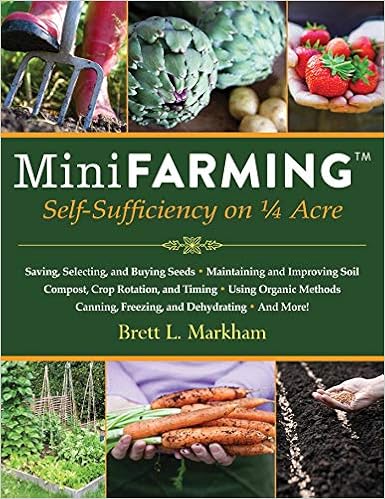
Mini Farming: Self-Sufficiency on 1/4 Acre, by Brett L. Markham

Ebook Mini Farming: Self-Sufficiency on 1/4 Acre, by Brett L. Markham
Need sources? From any kind of the books? Attempt Mini Farming: Self-Sufficiency On 1/4 Acre, By Brett L. Markham This publication can provide you the ideas for addressing your obligations? Obtaining brief target date? Are you still perplexed in obtaining the brand-new motivation? This publication will be always offered for you. Yeah, certainly, this availability will concern with the very same topic of this book. When you truly need the suggestions related to this comparable topic, you might not need to be puzzled to seek for various other resource.
Checking out is enjoyable, anyone believe? Need to be! The sensation of you to read will depend upon some factors. The factors are guide to read, the circumstance when reading, and also the related book and also writer of the book to review. And also now, we will provide Mini Farming: Self-Sufficiency On 1/4 Acre, By Brett L. Markham as one of guides in this site that is much suggested. Book is one fashion for you to reach success book ends up being a device that you can consider reading materials.
Exactly what should you assume much more? Time to get this Mini Farming: Self-Sufficiency On 1/4 Acre, By Brett L. Markham It is very easy after that. You can just sit as well as stay in your area to get this publication Mini Farming: Self-Sufficiency On 1/4 Acre, By Brett L. Markham Why? It is online publication store that offer so many collections of the referred books. So, simply with internet link, you can take pleasure in downloading this book Mini Farming: Self-Sufficiency On 1/4 Acre, By Brett L. Markham and numbers of publications that are hunted for currently. By seeing the web link page download that we have supplied, guide Mini Farming: Self-Sufficiency On 1/4 Acre, By Brett L. Markham that you refer a lot can be located. Simply save the requested book downloaded and then you could delight in guide to read each time and area you desire.
Don't worry, the material is exact same. It could specifically make easier to read. When you have actually the published one, you should bring that product as well as fill the bag. You might likewise feel so difficult to discover the published book in guide shop. It will lose your time to go for walking ahead to guide shop and search guide racks by shelfs. It is just one of the benefits to take when choosing the soft documents Mini Farming: Self-Sufficiency On 1/4 Acre, By Brett L. Markham as the option for analysis. This can assist you to optimize your complimentary or extra time for day-to-day.
Review
“A concept destined to appeal to that intrepid individual whose independent nature finds the idea of abandoning the grocery store alluring.†(Carol Haggas - Booklist)“A helpful addition, alongside Bartholomew and Jeavons, for the serious DIY gardener.†(Margaret Heller - Library Journal)
Read more
About the Author
Brett L. Markham is an engineer, third-generation farmer, and polymath. Using the methods explained in his book, he runs a profitable, Certiï¬ed Naturally Grown mini farm on less than half an acre. Brett works full time as an engineer for a broadband ISP and farms in his spare time. He lives in New Ipswich, New Hampshire.
Read more
Product details
Paperback: 240 pages
Publisher: Skyhorse; 32638th edition (April 1, 2010)
Language: English
ISBN-10: 1602399840
ISBN-13: 978-1602399846
Product Dimensions:
8.5 x 0.8 x 11 inches
Shipping Weight: 2.6 pounds (View shipping rates and policies)
Average Customer Review:
4.4 out of 5 stars
715 customer reviews
Amazon Best Sellers Rank:
#4,241 in Books (See Top 100 in Books)
Great book, I just don't care for the part on killing Chickens. I could never kill anything and certainly couldn't slaughter anything. I'm no vegetarian, but it's just a personal thing where that is concerned. I would however be one before I'd kill an animal myself or even watch it. Outside of that chapter the rest of the book is fabulous & has great ideas. It did also inform me as to what the chicken industry is doing in our country and it did influence how I will purchase eggs now and in the future. I would however like to comment that the section on raising chickens for eggs was much appreciated & could be useful to anyone. It includes what to feed them, how to house them, when to get the eggs from the nests, what to do to prevent vitamin difficencies etc.. The gardening part of the book is well thought out and is an easy read. Much information is included, including how to collect your own seed so you do not need to always purchase seeds every year which is awesome :o The book also tells you how to fertilize etc. I combined this book with techniques from Container Gardening and 4 Season Harvest & have had much success in a patio garden that is 14X8 and have never grown anything in my life. I've been eating fresh produce for the entire summer now, and have a fall garden currently growning so it has been great and will continue to be wonderful through the winter. I do not plan to always live in a condo so that is one reason why I went ahead and incorporated techniques from this book into my current gardening plan. It's an easy read and can be used in manhy ways other than out in the country :o)
I have read maybe fifty books on farming techniques, and had really high expectations for this one. Sadly, it is one of three books I have asked a refund on since I started buying books on Amazon back around 2001. I was dismayed, disgusted and disappointed by the complete lack of respect this writer showed his readers. Instead of illustrating his ideas, and giving us details, each chapter followed the same formula: " A: here is an idea I stole from someone else. B: this is who I stole it from. C: brief summary of stolen idea. D: want to know more? Read a book from the original author of the idea I stole!" I'm not making this up! Please save yourself the money and buy "Urban Homestead " by Kelly Coyne or "Gaia's Garden" by Toby Hemenway or better yet, subscribe to Mother Earth News instead. These are only 3 of the myriad of truly helpful publications you would be better off buying. BTW, Mother Earth News has a wonderful website wth free info. So does Urban Homestead. Forewarned is forearmed. Yards are for food, not chemicals. :-)
This was quite a disappointment. We have a couple of acres that we're planning on farming when we retire and we figured that if you can do it on a quarter acre then it should be easy to grow most of what we need on our property so we bought this in print and kindle. We should have saved our money on both.The book completely fails to deliver on the promise, in fact, there's almost no mention of how to grow intensively and virtually no pictures of the author or anyone else actually doing it. There are a few stock photos of vegetables and then maybe 20 or 30 copies of the same photo of long grass in the book. What's up with that? I eat grass - once converted to beef - but all those grass pictures could have been replaced with pictures of his own 1/4 acre intensive garden - assuming he actually has one. It's not clear at all from the book.90% of the content of the book is standard articles easily available in any gardening book, magazine, website, or a dozen other places on how to create compost, how to plant, how to harvest, etc... nothing at all that is unique or special to an intensive garden. Look at urbanhomestead dot org for an example of great pictures of intensive gardening. You'll find nothing at all like that in this book.
So much information in this book! My wife and I were new to gardening and this book is now our go to reference for anything garden related!
While I've maintained small gardens and potted plants for years, for a good 5 years I've casually kept a 1,000 square foot garden. I've mostly winged it, sometimes with surprisingly good results, other times with dismal harvests. But, in any event, never consistent year over year results.I picked up this book to take my gardening to the next level and broaden my horizons a bit. And, in short, I'm very satisfied with the insights and guidance I've gleaned from this book. I'd go so far as to say that while you don't need a background in gardening to benefit from this book, I think this book is a perfect fit for people in my situation. Here's pros and cons from my perspective.Pros:- The content of each chapter is very well organized, with concepts building onto one another very neatly.- And for that matter, the broader subject matters of the chapters takes one through the process of planning, preparing, selecting, timing, managing, etc. most everything one would need to successfully grow a garden.- This book strikes a good balance between giving you the key information you need for any one aspect of self sufficient gardening, but not inundating you with to much detail. In other words, this book threads the needle on delivering a lot of helpful information, while still feeling like an easy read.- I've seen other reviews for this book that complain that the author pretty much rips off others ideas and re-packages them for profit. I read quite a bit, and have over the years seen serious examples of what these other reviewers are talking about. But, in the case of this book, while the author informs on alternative (and even competing models) for gardening, the author always informs the user on what in his experience has or has NOT worked from various models, how he has modified some of those ideas to work in his growing climate, and where he completely parts ways from others' techniques and espouses his own approach (including very clear instruction on how to use his modified or totally unique processes).- Finally, where possible, the author provides the equivalent of 'modified workouts' for those less fit (my words, not his) in their gardening abilities. In other words, the author provides sufficient detail on what might be the most efficient and beneficial approach to say irrigation or composting, but then across those and other subjects covered in the book, he provides a less expensive/quicker/initially easier alternative for those lacking the time, resources, space, skills, etc. to fully implement the best possible approach for one aspect or another of gardening. For example, as I'll be looking to expand my garden this next spring, I fully intend to utilize some of the quicker soil prep techniques offered up in this book for use in a pinch while I build up my long-term composting and soil amendment routines.Cons:- While some of the chapters really cover all the bases for the targeted subject matter (i.e. plant spacing, soil prep, etc.). Others give you just enough to run with, but definitely leave you wanting more. A good example of this would be Chapter 7 ("Time and Yield"). While the author definitely gives a good broad overview of timing techniques (i.e. succession planting, timed planting, interplanting etc.), for such an important subject matter, I was surprised (in a disappointed kind of way) by just how short this chapter was. I live in Michigan, with a relatively short growing season. I see this topic as critical for people in shorter growing zones like me, and apart from a quick overview of each of the techniques used to maximize productivity, and a handful of real-world examples of plant groups that work well for things like succession planting (taking into consideration their hardiness in colder climates), this chapter really leaves readers wanting.- While this book is beautifully illustrated, there's no doubting that the abundance of pretty pictures of garden produce, chickens, tools, etc. just serves as fill to make the book feel a bit more substantial in size than it need be. I don't want to over play this point, as A LOT of the illustrations (pictures/graphics/tables) are pertinent to the content of the book (and in any event, some amount of artwork is always nice to have), I think you could still produce this book, with many beautiful illustrations, and reduce it from its current 227 pages (including the index and notes pages) down to maybe 175 pages.
Mini Farming: Self-Sufficiency on 1/4 Acre, by Brett L. Markham PDF
Mini Farming: Self-Sufficiency on 1/4 Acre, by Brett L. Markham EPub
Mini Farming: Self-Sufficiency on 1/4 Acre, by Brett L. Markham Doc
Mini Farming: Self-Sufficiency on 1/4 Acre, by Brett L. Markham iBooks
Mini Farming: Self-Sufficiency on 1/4 Acre, by Brett L. Markham rtf
Mini Farming: Self-Sufficiency on 1/4 Acre, by Brett L. Markham Mobipocket
Mini Farming: Self-Sufficiency on 1/4 Acre, by Brett L. Markham Kindle


Posting Komentar